※本篇內文資訊參考如下※
- -
※更新文章日期: 2026-02-18
Pokémon GO 對戰系統PVP/GBL 2026年2月重大更新資訊
–
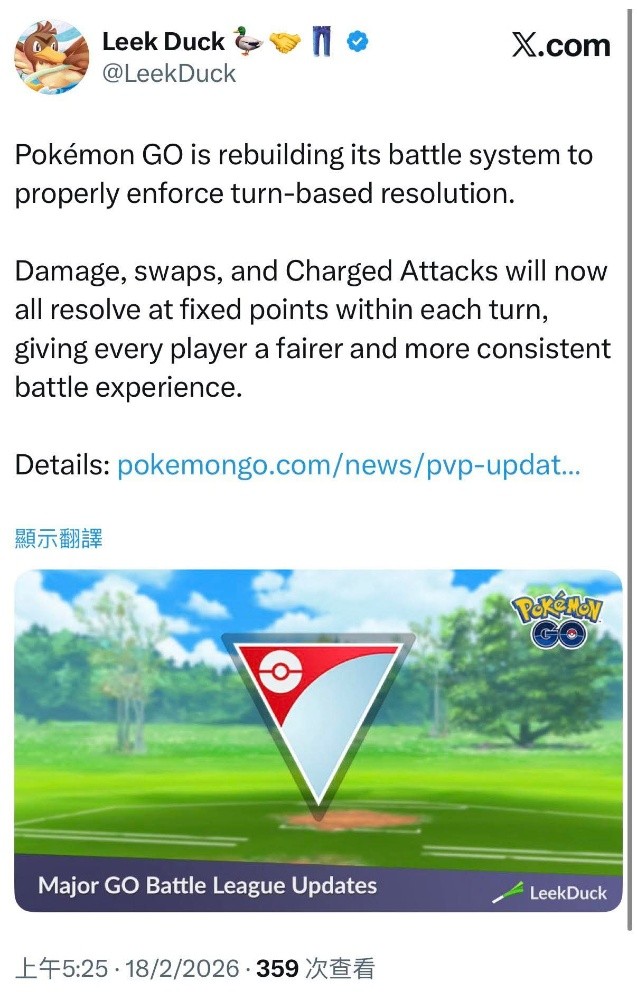
Leek Duck 🦆🤝👖 @LeekDuck
《Pokémon GO》正在重建其對戰系統,以確實執行**回合制(turn-based)**的判定。
傷害、換隻(swaps)以及特殊招式(Charged Attacks)現在都將在每一回合中的固定時間點進行判定,為每位玩家提供更公平、更一致的對戰體驗。
–
–
這是一則關於 Pokémon GO 對戰系統(PVP/GBL)2026年2月重大更新的詳細資訊。
這次更新被官方稱為「強化對戰基礎(Strengthening the Foundations)」,核心在於將原本容易受網路延遲影響的「即時制」判定,徹底改為嚴格的**「回合制(Turn-Based)」**邏輯。
–
📝 懶人包:2026 對戰系統重構重點
嚴格執行 0.5秒/回合:所有動作(傷害、換角、發招)都在回合的「固定時間點」結算,不再有因為手機快慢而產生的「偷招」或「掉幀」差異。
大招(Charged Attacks)機制改變:
發招時機:按下大招後,招式會固定在**「下一回合開始時」**啟動。
殘血必發:如果你的寶可夢在這一回合會被普攻打死,但你同時按下了大招,系統保證大招一定會發出去(解決了過去「有能量卻按不出來被點死」的 BUG)。
判定順序:大招的傷害與效果,會比「在大招動畫期間結束的普攻」優先結算。
換角(Swaps)成本:
主動換角:現在固定消耗 1 回合(即 0.5秒)。這意味著換角不再是「瞬間無縫」,而是有一個明確的時間成本。
例外:在大招動畫結束時進行的換角(CCT),不消耗回合。
傷害與能量結算:統一在每一回合的**「回合結束(End of Turn)」**時結算。
–
⚔️ 深度攻略分析
1. 「偷小招(Sneaking)」與「阻斷(Denial)」的終結
舊機制:過去在發大招時,對手的小招是否能「偷」進來造成傷害和回能,很大程度取決於運氣和網路延遲。
新機制:因為大招固定在「下一回合」啟動,且傷害判定優先於該回合結束的小招。這讓「數招(Counting)」變得絕對可靠。
攻略點:玩家必須重新記憶各個小招的回合數(1T, 2T, 3T, 4T, 5T)。現在如果你算準了回合發招,對手就絕對無法偷到額外的能量或傷害。
–
2. 「同發優先權(CMP)」與殘血博弈
舊機制:常常發生我按了大招,但因為延遲,先被對手的小招點死,導致帶著滿滿的能量下場(含恨而終)。
新機制:系統保證「只要你在死亡的同一回合按下大招,大招就會優先結算」。
戰術影響:在殘血對局中,玩家可以更積極地農能量到最後一刻,而不用擔心因為延遲被「點死」。這大幅提升了極限操作(Farm down)的容錯率。
3. 換角擋招(Catching)的新邏輯
舊機制:換角是瞬發的,這導致「切角擋招(Sacrificial Swap)」需要極高的反應速度和運氣。
新機制:因為「主動換角消耗 1 回合」,且「大招在下一回合啟動」。
戰術影響:這讓換角的節奏變得更像「預判」而非單純「拼手速」。你需要在對手發招的「前一回合」或「該回合」準確輸入指令。系統現在支援「預約換角(Queue a swap)」,讓你在大招結束時能無縫切換,操作手感會更滑順。
4. 能量管理更透明
由於傷害和能量都在「回合結束」時統一結算,視覺上的血條扣減和能量增加會完全同步,不再有「血條假動作(Rubber-banding)」的問題。這對於判斷「對手是否已經集滿大招」會更加直觀。
–
新手向:強調現在對戰更公平,不會因為手機爛就輸在起跑點。
老手向:強調「數招」的重要性回歸,以及「換角耗時 1 回合」對心理博弈的影響。
「舊制 vs 新制」的對照表
–
| 項目 | 舊系統 (Old System) | 新系統 (New System 2026) |
| 回合判定 | 即時制,受延遲影響 | 嚴格回合制 (Fixed Points) |
| 大招發動 | 立即 (可能有延遲) | 固定於「下一回合」開始 |
| 殘血發招 | 常因延遲被普攻打死 (CMP失敗) | 保證發動 (優先於普攻結算) |
| 換角成本 | 無 (視為瞬發) | 消耗 1 回合 (0.5秒) |
| 偷小招 (Sneak) | 隨機/不穩定 (RNG) | 機制化/可預測 (Consistent) |
–
Strengthening the Foundations of Pokémon GO Trainer Battles
(強化 Pokémon GO 訓練家對戰的基礎)
🔗 https://pokemongolive.com/news/pvp-updates2026
–
Feb 18, 2026
Strengthening the Foundations of Pokémon GO Trainer Battles
Trainers,
From the beginning, Pokémon GO Trainer Battles were designed under two principles. The gameplay had to be fast paced for the mobile landscape so that players could have short experiences while exploring the world, and battles needed to be dynamic enough to invoke a sense of skill when managing your Pokémon. Given the same game state and decisions, outcomes should be driven by player choices, not game state quirks, device differences, or momentary network hiccups.
As the player versus player (PvP) community has grown more competitive, players have naturally pushed the system to its limits. In doing so, they may have noticed situations where battles did not always behave as consistently as expected. These moments were rare, but at higher levels of play, even small inconsistencies could have an outsized impact.
Rather than continuing to address these issues one at a time, the team took a broader approach by rebuilding the core battle system. The goal was to harden the foundations of all battle modes, including PvP, so that battles consistently reflect player skill while maintaining the fast, responsive feel players expect. With a systemic change like this, players can expect to see changes. To help find a balance between addressing existing consistency issues and game feel, we’ve solicited feedback during development from the community as well as various players from both the grassroots competitive scene and the official Pokémon GO Championship Series.
Supporting Skill-Based Battles
Battles in Pokémon GO have very short, fixed-duration turns. This structure helps maintain a consistent battle state while delivering smooth and responsive gameplay.
In the past, some interactions could be influenced by when inputs arrived within those turns. Most of the time this worked as intended, but differences in network conditions or device performance could occasionally affect how actions were resolved.
The updated battle system reinforces turn-based resolution at a foundational level, better mitigating the impact of network hiccups and device performance differences. While connectivity will always play a role in online play, normal variations within turn and network tolerances should no longer change the outcome of identical decisions for a given game state.
Major Changes
Damage Resolves at the End of the Turn
Previously, damage could resolve at different points within a turn, depending on network conditions. With Fast Attacks that take one turn, this sometimes meant one player’s move was resolved slightly earlier than the other player’s under certain conditions.
New expected behavior:
Damage resolves at the end of each turn.
Energy is awarded at the same time damage is resolved.
Charged Attacks will now consistently resolve if used on the same turn the user is about to faint from a Fast Attack.
What this means for players:
One-turn Fast Attacks now reliably tie when used on the same turn.
Energy gains are predictable and easier to track.
Outcomes depend on decisions and timing within the turn system, not a player’s local network speed or variance due to provider differences.
Swaps Resolve Before Damage
Another area players may notice changes is around swapping Pokémon to absorb an incoming attack.
Previously, whether damage landed on the outgoing or incoming Pokémon could depend on timing of the swap as well as connection quality.
New expected behavior:
Swaps always resolve before damage.
What this means for players:
When you swap on the same turn as an opponent’s Fast Attack completes, the incoming Pokémon will consistently take the damage.
When swapping on the same turn that your opponent’s Charged Attack starts, the incoming Pokemon will be the recipient of the Charged Attack.
Swapping to absorb incoming damage will behave the same way across different network conditions within the turn.
Swap decisions are more reliable and easier to plan around.
Clear and Consistent Swap Costs
Swap timing has also been standardized.
A quick swap is a voluntary swap made during normal battle flow. A forced swap happens when a Pokémon faints and a replacement must be chosen.
New expected behavior:
Quick swaps always cost one turn.
Forced swaps do not cost a turn.
Swaps during the end of the Charged Attack sequence will not cost a turn.
What this means for players:
Swap timing is clear and predictable.
Inconsistent delays around Charged Attacks and swaps have been removed.
Planning around swaps is more intuitive, especially in tight endgame scenarios.
Input delays due to swap reliability are eliminated.
Charged Attacks Start on the Next Turn
Charged Attack timing has been standardized so that Charged Attacks always begin at the start of the following turn after being triggered.
Previously, Charged Attacks could begin immediately, which created uneven timing windows and made some interactions more sensitive to latency or device performance.
New expected behavior:
Charged Attacks begin at the start of the next turn.
Charged Attack damage and effects will always resolve before Fast Attacks that finish during the Charged Attack sequence.
This means that stat changes, as well as effects that alter a Pokémon, will occur before any incoming Fast Attack effects are applied.
What this means for players:
Timing windows around Charged Attacks are more consistent.
Fast Attack “Sneak”
Fast Attacks started at the beginning of an opponent’s Charged Attack rely less on connection quality or device speed.
Fast Attacks started at the beginning of an opponent’s Charged Attack can only occur on the exact turn a Charged Attack is used.
Fast Attack “Leak”
Fast Attacks that finish during an opponent’s Charged Attack will consistently be applied after the Charged Attack is completed. This means that Charged Attacks that cause stat changes will be applied before the Fast Attack is applied.
Charged Attack outcomes are more consistent, barring chance-based effects such as stat changes from attacks like Night Slash.
Earlier Swap UI During Charged Attacks
The swap flyout now appears slightly earlier as a Charged Attack sequence is ending.
What this means for players:
It is easier to queue a swap as a Charged Attack finishes.
Inputs are less likely to be missed during fast-paced moments.
Visual feedback better matches when the system is ready for your next action.
Battles Continue Even If a Trainer Disconnects
Previously, battles depended heavily on continuous communication from both players. If a player disconnected or stopped sending input, game state and outcomes could become unclear.
This was especially noticeable in situations where both players were on the brink of a knockout and order mattered, especially for setting up energy or alignment on the incoming Pokémon.
New expected behavior:
Both players must connect before a battle begins.
Battles continue to progress even if a client stops responding.
Battles will always continue to provide visual feedback if either player stops tapping.
What this means for players:
Battles resolve cleanly if an opponent disconnects or leaves the match.
Outcomes around knockouts, energy gain, and alignment are clear and consistent.
Delays due to player input during a Charged Attack will no longer impact game pacing and flow.
Situations where both players do not want to submit actions are now more clear.
HP Bar Animation Updates
With damage resolving at the end of turns, HP bar behavior has been updated to better communicate when damage is pending versus when it is finalized.
In rare Charged Attack timing scenarios, players may briefly see pending damage before resolution. Rest assured that the HP bar animations resolve only when damage is applied.
What This Means for Competitive Play
Together, these updates strengthen the competitive experience, improving reliability and fairness for all Trainers and leading to the following.
Consistent outcomes for identical game states and decisions.
Reduced sensitivity to latency and device performance.
Clearer and more reliable timing for advanced techniques.
For experienced players, this means cleaner timing, more dependable swap interactions with Charged Attacks, damage registering predictably, and fewer moments where outcomes feel unexpected. For all players, it means battles that more accurately reflect skillful play.
Looking Ahead
This update focuses on reinforcing the core battle system so future updates across all battle modes can build on a stable and consistent foundation.
We will continue monitoring battles as these changes roll out, adjusting as necessary. We appreciate the community’s patience and continued passion for the GO Battle League.
We will see you in GBL! Just maybe take it easier on my Shadow Dragonite…
Please be aware of your surroundings and follow guidelines from local health authorities when playing Pokémon GO. Upcoming events are subject to change. Be sure to follow us on social media, opt in to receiving push notifications, and subscribe to our emails to stay updated.—The Pokémon GO team
–
[官方公告翻譯] 開發者日記:重建對戰系統,強化 Pokémon GO 的對戰基礎
親愛的訓練家們:
正如我們在社群媒體上所分享的,《Pokémon GO》正在徹底重建其對戰系統,以確實執行**回合制(turn-based)**的判定機制。這項更新旨在解決長期存在的延遲與判定不一致問題,為所有訓練家提供更公平的競技環境。
以下是本次更新的詳細技術改動:
1. 從「即時模擬」轉向「嚴格回合制」
過去的對戰系統雖然以 0.5 秒為一個回合,但在判定上仍依賴即時(Real-time)的伺服器通訊,這導致了「偷小招(Sneaking)」或「阻斷(Denial)」等受網路延遲影響的現象。
更新後: 系統將嚴格執行回合序列。傷害、換角(Swaps)以及特殊招式(Charged Attacks)現在都將在每一回合內的固定時間點進行結算。
2. 動作結算順序(Resolution Order)
為了消除不確定性,每個回合(0.5秒)內的動作將依照以下固定順序處理:
一般招式(Fast Attacks)判定:優先計算並結算當前進行中的一般招式傷害與能量。
換角(Swaps)判定:處理訓練家的換角請求。
特殊招式(Charged Attacks)判定:執行已啟動的特殊招式。
這意味著,如果你在對手發動特殊招式的同一回合被一般招式擊倒,系統現在會更精確地判定你的特殊招式是否能夠優先發出(CMP 機制將更穩定)。
3. 換角機制的調整
在新的回合制架構下,主動換角現在將明確消耗 1 個回合(0.5秒)。
這代表換角不再是「瞬間無縫」的動作,玩家在切換寶可夢時會有一瞬間的空檔,這將考驗玩家對於換角時機的預判,而非單純的手速反應。
4. 修正「偷招」與「掉招」問題
由於傷害與能量現在於回合的固定點結算,「偷小招(Fast Move Sneaking)」的情形將不再隨機發生。
當你發動特殊招式時,對手的一般招式是否會造成傷害,將完全取決於該招式的回合數(Turns)是否剛好結束,而非取決於網路延遲。這讓「數招(Counting Moves)」的技巧變得絕對可靠。
5. 視覺與數據的同步
為了配合底層重構,我們也更新了對戰的視覺回饋。血量的扣減與能量的增加將更即時且準確地反映伺服器端的狀態,減少「血條回溯(Rubber-banding)」的視覺錯誤。
開發團隊的話:
我們知道這些改變將會影響現有的對戰策略與肌肉記憶,但我們相信建立一個堅實、可預測且公平的「回合制基礎」,對於《Pokémon GO》電競化的未來至關重要。
感謝您與我們一同邁向新的對戰紀元!
–
–